
Our latest research has just been officially published in Optics Continuum! For the first time, we have demonstrated high-resolution, broadband mid-IR frequency comb spectroscopy under low-pressure conditions (down to 50 Torr) inside an antiresonant hollow-core fiber (ARHCF). It opens up exciting new possibilities for precise, highly selective gas sensing across diverse experimental environments.
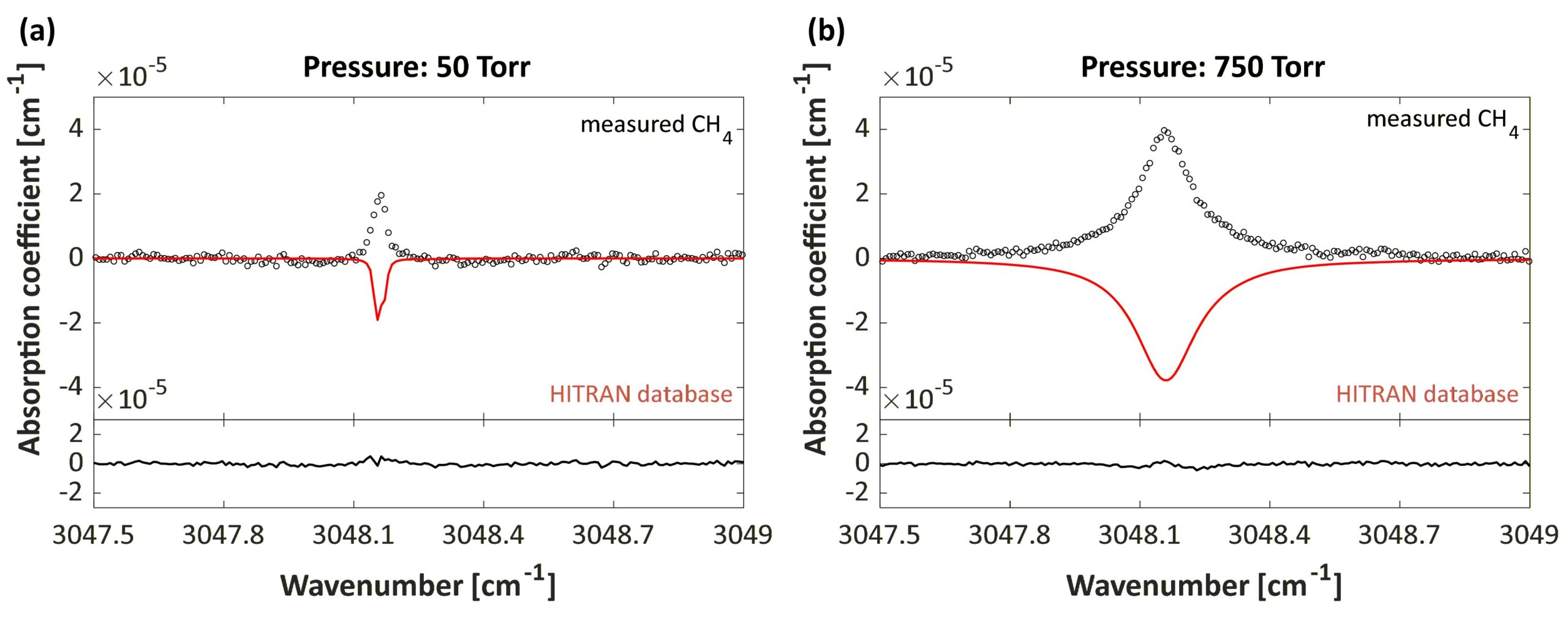
Close-up of a selected CH4 absorption transition and its residuals in the ARHCF at (a) 50 Torr and (b) 750 Torr. Black circles: experimental data, red lines: inverted HITRAN simulations.
The basis of this work is our home-built, low-noise laser platform, in which we paired a Kerr-lens mode-locked Cr:ZnS oscillator with a ZBLAN fluoride fiber to generate the soliton self-frequency shift (SSFS) and obtain an exceptionally stable, broad mid-IR spectrum centered at 3270 nm. By launching this highly coherent light source into a self-fabricated 30-meter-long ARHCF, we successfully maintained stable gas pressures from 750 Torr down to 50 Torr, suppressing collision-induced line broadening and allowing us to retrieve methane (CH4) absorption features. This entire setup achieved an noise-equivalent absorption coefficient of of 1.4 × 10⁻⁷ cm-1 Hz-1/2 per spectral element, outperforming traditional, bulky free-space multipass cells by providing superior sensitivity while requiring 1000 times less gas volume and maintaining a match with HITRAN database models.
Paper: Dorota Tomaszewska-Rolla, Piotr Jaworski, Dakun Wu, Fei Yu, Maciej Kowalczyk, „Broadband spectroscopy using Cr:ZnS mode-locked laser in low-pressure conditions with an antiresonant hollow-core fiber,” Opt. Continuum 5, 2322-2333 (2026)